Hereditary diseases occur in most if not all dog breeds. There are a number of such diseases that occur in border collies but we are fortunate enough to have a variety of DNA tests available and health testing schemes in place that can help breeders, thus making the Border Collie one of the soundest breeds around. As a prospective puppy buyer it is important to do your homework, these health tests are not mandatory and are up to the discretion of each individual breeder.
Hip Dysplasia
Hip Dysplasia (HD) is caused by the abnormal formation of the hip ball and socket joint. Normally the ball should fit snugly into the hip socket, forming a pivot point. Some dogs are born with a genetic predisposition for hip dysplasia; at birth their hips are normal but as they grow, the hip joint becomes a malformed structure so that the ball no longer fits snugly into the socket and cannot rotate smoothly.
HD is a relatively common problem in most breeds of dog and can be a very painful and terribly debilitating disease, in bad cases requiring surgery and in the worst euthanasia.
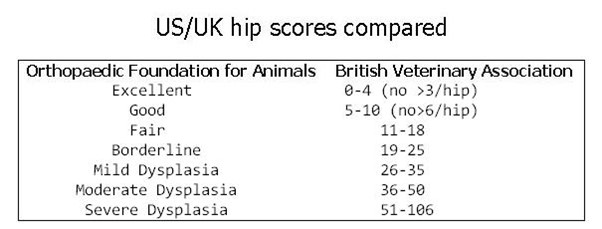
The Kennel Club and BVA have a testing scheme in an attempt to avoid having puppies born with this genetic predisposition. This scheme involves dogs over 12 months of age having their hips x-rayed and sent to the BVA panel of experts for ‘scoring’; they produce a score for the joints and angles on each hip to give a score for left and right. The higher the score, the worse the dogs hips are, the lowest possible score is 0:0 = 0 and the highest 53:53 = 106.
The BVA publish an annual list of all KC breeds with the average score although in many people’s opinion this average is artificially low as many people will not send off poor x-rays and dogs diagnosed with HD will also not be scored. In most other European countries, the breed clubs make it obligatory that a dog be hip scored before it is bred from and only those with acceptable hips are allowed, this is in my view, a much better system.
The current UK average for border collies is 13. This system of scoring varies around the world but below is a table comparing our system with that used in the USA.
Read More about the BVA Canine Health Scheme for Hip Dysplasia
Please note….Hip Dysplasia CANNOT BE CAUSED by ‘over-exercise’…the genetic predisposition for malformation of the hips along with a lot of exercise in a pup may aggravate the condition but a normal healthy and well reared puppy with perfectly good hip joints will not develop hip dysplasia through exercise.
Narrow Angle Glaucoma
Narrow Angle Glaucoma (Goniodysgenesis)
Glaucoma is the name given to a group of eye diseases characterised by an increase in intraocular pressure, this causes pathological changes in the optic disk and visual field defects. It’s a very painful condition that leads to varying degrees of blindness and in it’s severest form can result in removal of the affected eye or euthanasia.
Glaucoma can initially be categorised as PRIMARY, where there is an increase in intraocular pressure occurring in an eye without previous disease or injury or SECONDARY where an injury or prior disease/infection leads to the condition.
In the case of Primary Glaucoma we can assume it is congenital and inherited. This is something that has not been seen in border collies until fairly recently so much of what we know has been taken from research in other affected breeds such as the flat coated retriever. This hereditary form of glaucoma in border collies takes the form of narrow-angle glaucoma which is characterised by a shallow anterior chamber and a narrow angle, in which filtration is compromised as a result of the iris blocking the angle and impairment of outflow of aqueous humor leading to a painful build up of pressure within the eye.
There is a physical eye examination that assesses the structure of the eye and these angles. Gonioscopy is not part of the standard eye examination but can be carried out by an opthamologist on it’s own or at the same time as a standard eye exam. It’s quite an awkward test because it involves the dog having a local anaesthetic in the eye and then a large round lens placed on the eyeball for the opthamologist to look through. It’s important that the dog stays as motionless as possible in order that the vet can carry out a full examination. It may be necessary to sedate dogs that won’t sit still.
Because goniodysgenesis it’s not currently on the BVA list of tests for the border collie the examiner will not complete that part of the form but will simply write in the comments section e.g. Normal drainage angles – Unaffected or narrow drainage angles – Affected and anything else they may have noted. As with any test of this nature the result is subjective, and in borderline cases what one examiner may pass another may fail.
It is important to note that gonioscopy is NOT a test for glaucoma, it is simply an examination of the eye to assess any predisposition for narrow angle glaucoma. A dog that tests affected for goniodysgenesis will not necessarily go on to develop glaucoma, indeed many do not. Should a dog test ‘affected’ it is important that it have regular eye examinations in future. Once a dog is tested ‘unaffected’ it need not be tested again.
While it is accepted that the narrow angle glaucoma is hereditary the mode of inheritance is not know. In my opinion, it seems unlikely that we are dealing with an autosomal gene here and much more likely that the cause is polygenic (i.e. involves more than one gene or modifier) so we may well never have a definitive genetic test.
In this way we can draw some similarities to hip dysplasia and use gonioscopy results as a breeding tool in a similar way to hip scores. Selecting unaffected dogs from unaffected lines as best we can. It will still be possible that an affected pup can be produced from two unaffected parents, in the same way that two parents with low hip scores may produce a pup with HD. The selection based on test results will only decrease the odds of this happening and at this time, it’s all we have to go on.
As more dogs get tested and more results are published we will be able to build up a better picture of the extent and heritability of this problem within the breed.
cPRA
Centralised Progressive Retinal Atrophy (cPRA)
As the name suggests, cPRA is a form of blindness affecting the light sensitive portion of the eye, this blindness becomes gradually worse over time (hence progressive).
Due to the progressive nature of the disease, PRA cannot be diagnosed until a dog is around 18 months old which is when they usually have their first adult eye test, dogs used for breeding should be tested regularly thereafter.
Puppies registered with the ISDS cannot be ‘pink papered’ until both their parents have successfully passed their 2 year eye test, the society then issues a pink coloured registration paper, indicating that the pup is from fully eye tested stock.
cPRA has been something of a success story in border collies and is now EXTREMELY rare; much of this is thought to be down to the improvement in dogs nutrition with the introduction of complete foods, since cPRA is thought to be mainly down to a defeciency in Vitamin A.
Read more about the BVA Canine Eye Scheme.
Collie Eye Anomaly (CEA)
Very briefly, CEA is a condition that affects the normal anatomy of the retina and other deeper structures of the eye, this can be irregularity in structure or even holes/pockets. In it’s mildest form it will not affect the dog, in it’s severest it will cause detached retina’s/complete blindness.
CEA is caused by a recessive gene which both parents must carry to produce affected pups.
An animal will have 2 copies of every gene, one coming from the sire and one from the dam.
If an animal has two normal copies of the gene, it is classed as ‘normal’ and cannot ever produce affected pups.
If an animal has one normal gene and one defective gene it is classed as a ‘carrier’, mated to another animal with the defective gene it could produce affected pups. If mated to a ‘normal’ animal it will at worst produce more carriers but may also produce some ‘normals’
(Note: A carrier DOES NOT have the disease)
If an animal had two copies of the defective gene it is classed as ‘Affected’ and will actually have the disease. If bred from, this animal can only produce carrier and/or affected pups.
The table below shows the likely outcome of various matings…

The results shown in grey are what everyone wants to avoid…nobody wants to produce affected pups so these are the matings to avoid – carrier to carrier, carrier to affected, affected to affected.
Prior to the introduction of a DNA test; eye testing was first carried out on pups at around the age of 6 weeks by one of only 30 BVA approved veterinarians around the country. This initial test is for CEA only and this period between 5 and 8 weeks of age is the best time for diagnosis of this condition. If a puppy is affected it is an indication that both of it’s parents are carriers of the CEA gene. While the Kennel club does not impose any breeding restrictions from affected dogs or carriers the International Sheepdog Society (ISDS) does not allow the registration of affected pups or their progeny and does not allow the registration of puppies by parents that have produced a CEA/PRA affected pup on more than one occasion (they allow one due to the possibility of a mis-mating). The ISDS is striving to eradicate this disease from the breed. Puppies that successfully pass this eye test are issued with a litter certificate.
Passing an eye examinination at 6 weeks indicates the puppy is not AFFECTED by the disease but the physical examination cannot tell you which puppies are carriers of the gene. The recent introduction of DNA testing for the CEA gene by American laboratory, OptiGen has revolutionised breeding of border collies to a certain extent…although it can be quite expensive, we can now DNA test all breeding stock to see which animals are affected, which are carriers of the gene and which are DNA ‘normal’. This means there need never be any more affected puppies produced…we can ensure that by breeding carrier/affected animals to ‘normal’ animals the puppies cannot ever be affected by the disease. Since this test first became available in January 2005, ALL our dogs used for breeding are DNA tested in this way (or genetically clear by parentage). The introduction of this DNA test means that CEA has been eliminated within responsible breeding programs.
CL
Ceroid Lipofucinosis (CL) Also known as ‘Storage Disease’ (or ‘Battens Disease’ when it occurs in humans)
CL is a fatal congenital disease which affects the nerve cells of the body, it has been found in a number of dog breeds and is fortunately rare in border collies.
Symptoms do not usually occur until the affected animal reaches around 12-18 months old but the disease progresses rapidly once the initial signs appear and euthanisia is usually the kindest option, there have been no reported cases surviving past 2 half years of age.
The clinical signs of the disease are:
Unreasonable apprehension or fear of familar objects/surroundings or slight disturbances.
An abnormal gait, the animal may be unsteady on it’s feet and have difficulty jumping, climbing or placing feet correctly.
Dementend behaviour, characterised by manic hyperactivity and outburts of rage.
Prior to the recent introduction of a DNA test, cases could only be confirmed by a brain biopsy during post mortem examination to give an accurate diagnosis. Thankfully this is no longer the case and DNA testing is available via OptiGen or Dr Alan Wilton at the University of New South Wales.
As with CEA and TNS, the genetic inheritence of CL is via a recessive gene so animals will fall into three categories of genetic status:
CLEAR has not inherited a defective gene.
CARRIER has inherited the defective gene from a parent.
AFFECTED has inherited the defective gene from both parents and has, or will develop, the disease
Using the DNA test, it is now therefore possible to ensure that no more affected puppies are born.
OCD
Osteochondritis Dissecans (OCD)
What is OCD?
OCD is a condition that occurs in growing puppies of larger breeds, primarily between the ages of 4-9 months, but can occur as late as 12 months or older. It is most commonly seen in the shoulder joint but can be seen in stifles, elbows, hocks or other joints. In approximately one third of the cases of OCD, the disease is bilateral (in both joints). Occasionally, it is present in several different joints in the same individual. It is seen twice as often in males as in females.
OCD is thought to be caused by a problem in the growth rate of the joint cartilage relative to the underlying subchondral bone. The cartilage over the bone in the joint becomes thickened and the growth of the underlying bone is altered. Because the joint is an area of movement and stress, this thickened cartilage is at risk of being torn, especially in the areas most subjected to trauma, stress and movement, such as the caudal area of the shoulder joint. When repeated trauma causes a flap of cartilage to tear away from the underlying bone, the condition becomes OCD. Because of the tear, the joint fluid can come in direct contact with sensitive areas of the now-exposed underlying bone and can cause pain. Lameness will usually be present in the dog at this time. If the cartilage flap remains attached, it will not re-attach and heal back into its original position. If the cartilage flap tears completely loose from the adjoining cartilage, it becomes a loose body in the joint called a “joint mouse”. Once the flap has detached, the torn area where the flap originated usually heals when the lesion is filled in with fibrocartilage, a type of “scar” cartilage. Joint mice may float around in the joint, eventually being broken down and absorbed, or they may be nourished by the joint fluid and grow to a larger size than the original loose cartilage body. Possible complications arise when joint mice attach themselves to other areas in the joint or become entrapped it the bicipital tendon sheath, causing irritation, obstruction of movement and pain. The breakdown of cartilage from these various processes may cause inflammation, pain and the eventual development of secondary osteoarthritis in the affected joint.
Is it inherited?
OCD is a considered to be a common disease in large and rapidly growing breeds of dogs, with most affected breeds averaging over 60 lbs. However, some medium breeds, such as the Brittany spaniel, bull terrier, greyhound and border collie, also have a high incidence of this disease. Although the factors that cause OCD are not completely resolved, direct factors considered to be involved in the development of OCD are rapid growth and trauma to the joint. Indirect factors affecting rapid growth include nutrition, hormones, and genetic predisposition to rapid growth and large size. Indirect influences that may lead to increased trauma to the joint include conformation and behavior, which are also influenced by heredity. Therefore, the genetic link for most types of OCD is considered to be indirect, that is, an inherited tendency. Certain sites for OCD lesions, such as the elbow, appear to have a greater direct genetic contribution and a higher heritability than other sites, such as the shoulder. The most important contributing factor in OCD of the shoulder, the most common site, is thought to be trauma.
Border collies have a higher incidence of OCD than might be expected for their size and the weight bearing stress on their joints. It would seem likely that behavioral characteristics common to border collies could contribute to the increased occurrence of OCD in this breed. The high energy levels, athletic ability, stamina and quick reflexes for fast turns and speed changes many border collies possess could predispose them to trauma and stress in joints that most other breeds of similar size would not commonly experience. The overall increased incidence in males for this disease is thought to be due to the increased growth spurt in the male around the susceptible time period for OCD development. As well, it is tempting to speculate that behavioral factors common to males might also be involved in this increased susceptibility.
How can it be prevented?
As in many other developmental skeletal problems, an imbalance of calories, protein and nutrients can increase the occurrence of OCD. In general, rapid weight gain in puppies at the critical time period between 4-9 months predisposes larger breed dogs to OCD. High intake of calcium and protein has been implicated in the development of this condition. Therefore, care must be taken in feeding young puppies special “growth formula” puppy foods or high protein diets. Puppies need extra calcium and protein but free choice or overfeeding of these diets can be harmful. It is of interest to note that some dog food manufacturers have recently responded to health concerns of dog breeders and owners by formulating puppy foods specifically for large breed dogs.
Since trauma is a contributing factor to the development of OCD, it would be reasonable to monitor exercise in puppies, especially between the ages of 4-9 months. Activities such as excessive running and roughhousing with people or other dogs should be avoided. In addition, puppies shouldn’t engage in intense activities that encourage abrupt, fast turns, quick stops, or jumping, especially jumping from heights. Of course puppies need exercise and should be allowed to be reasonably active, but they should also be watched carefully so that they don’t do too much or do things that might cause injury.
article by C. Denise Wall, Ph.D and quoted from American Border Collie magazine
Colour Dilution Alopecia
Alopecia (hair loss) related to dilute coat colour (Blue or Lilac in Border Collies) is a recognised condition in all breeds of dog where colour dilution occurs and is most commonly known as ‘Colour Dilution Alopecia’. At the cellular level, there are abnormalities of the hair follicles and uneven clumping of pigment (melanin) granules in the hair shafts in affected areas, this results in weakening of the hair which is often brittle to the touch and breaks very easily leading to areas of thinning of the hair and near baldness in the dilute pigmented areas (so any areas of white and/or tanpoint will not be affected)
This condition develops in some, but not all dogs with the dilution gene. In fact in border collies it is really quite rare and seen only in particular lines and mostly in very mild cases whereas approximately 93% of blue dobermans have the condition. Contrary to seemingly popular myth, CDA is no more likely to occur in a dilute dog from two dilute parents than any other dilute dog; it is the fact that the dog itself is dilute that makes it prone to the condition.
Contrary to all the literature I have read on this condition in other dog breeds, which suggests that the onset is around 6 months of age, affects the hair along the spine and flanks first and is often accompanied by skin conditions, my experience in border collies is quite different, possibly because they are a long coated breed and most other affected breeds are short coated. In border collies the condition is apparent in young pups as soon as their coat begins to grow longer, so at about 4 weeks. You usually notice it first on the extremeties and in the very mild cases it will manifest only as bald ears which often ‘fur up’ as the puppy gets older. In the severest of cases it will affect head, ears and legs at this early age and is particularly noticeable because of the unaffected areas of white where the coat grows as normal leaving the pup with a fluffy tail tip, feet and ‘mohican’ over the head. The rest of the coat will also be shorter than the littermates and often appear dull and coarse to the touch. In my experience this is only an aesthetic condition where the coat will always remain thin with longer guard hairs growing and giving the impression of coat but no undercoat developing beneath, the dog is perfectly happy and healthy, suffers no other skin conditions and leads an otherwise perfectly normal life.
Epilepsy
Epilepsy is a condition that occurs in most, if not all, breeds of dog as well as cross breeds. It can be very distressing for the dogs involved and their owners but the causes and possible genetic links are not known at this time, it is thought that genetic, dietary and environmental factors can all play a part.
Read More about this condition.

